







Since it launched into space on April 24, 1990, the Hubble Space Telescope has been an invaluable instrument to astronomers in unraveling the mysteries of the universe.
As it orbits the Earth from 340 miles above, the telescope has imaged distant galaxies, black holes, and planets, making over 1.7 million observations in its lifetime so far, according to NASA.
Scientists have published more than 22,000 studies using its data.
And (almost) every year, the Hubble team chooses a celestial object for the telescope to spend considerable time imaging that year, and releases a special photo to celebrate its birthday.
Here are 36 breathtaking images from Hubble’s 36 years in space.
NASA marked Hubble’s 35th anniversary in 2025 with a composite image of four of the telescope’s photos.
The top left image is a photo of Mars. The top right shows the planetary nebula NGC 2899. The Rosette Nebula is pictured at the bottom left, and the spiral galaxy NGC 5335 is on the bottom right.
Hubble’s 34th anniversary photo in 2024 showed the Little Dumbbell Nebula.
Located 3,400 light-years away in the Perseus constellation, the Little Dumbbell Nebula features a red giant star that is collapsing into a white dwarf.
Hubble photographed a nebula known as NGC 1333 in an image released for its 33rd birthday in 2023.
NGC 1333 is located in the Perseus molecular cloud about 960 light-years away.
This photo, released in 2022, shows a collection of five galaxies known as the Hickson Compact Group 40.
The five galaxies will eventually merge together in about 1 billion years.
NASA celebrated Hubble’s 31st anniversary in 2021 with a photo of the star AG Carinae.
Clouds of gas and dust surrounded the star.
For Hubble’s 30th birthday in 2020, an image titled “Cosmic Reef” showed two nebulae in the Large Magellanic Cloud.
Located 163,000 light-years away, the Large Magellanic Cloud is one of the Milky Way’s satellite galaxies.
A photo of the Southern Crab Nebula was shared for Hubble’s 29th birthday in 2019.
The Southern Crab Nebula features a double star in its center made of a red giant and a white dwarf.
NASA shared a photo of the Lagoon Nebula taken by Hubble in honor of the telescope’s 28th anniversary in 2018.
The Italian astronomer Giovanni Battista Hodierna was the first to catalog the Lagoon Nebula in 1654. Hubble’s photo only shows a snippet of the enormous nebula, which measures 55 light-years wide and 20 light-years tall.
For Hubble’s 27th anniversary in 2017, four photos were combined into one image showing a pair of galaxies 55 million light-years away.
The galaxies, NGC 4302 and NGC 4298, were photographed with Hubble’s Wide Field Camera 3.
Hubble’s 26th birthday image in 2016 showed a bubble nebula between 7,000 and 11,000 light-years away.
Bubble nebulae are formed by the solar wind of a nearby star crashing into a molecular cloud of dust and gas.
A photo of Westerlund 2, a giant cluster of about 3,000 stars, was the 25th anniversary image in 2015.
Westerlund 2 is located 20,000 light-years away,
Hubble’s 24th anniversary photo in 2014 showed this colorful plume of gas and bright stars, known as the Monkey Head Nebula.
Located within the Orion constellation, the Monkey Head Nebula is 6,400 light-years away.
For Hubble’s 23rd birthday in 2013, the team released this photo of the Horsehead Nebula in the Orion constellation.
The photo was taken with infrared imaging.
This image of the Tarantula Nebula marked Hubble’s 22nd anniversary in 2012.
The nebula is named for its glowing filaments that resemble spider legs.
This “rose,” released for Hubble’s 21st anniversary in 2011, showed two galaxies interacting with each other.
The bigger galaxy’s mass is five times larger than the smaller one, so it’s pulling the smaller one into a spiral shape. The pair of galaxies is called Arp 273.
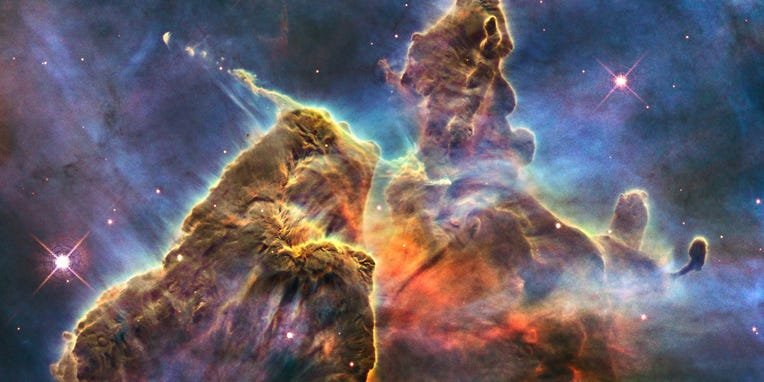
This image of the Carina Nebula was captured by the Hubble Space Telescope in 2010 and released for its 20th anniversary.
The photo showed pillars of gas where stars are born.
Hubble’s 19th anniversary image in 2009 was titled “Fountain of Youth.”
The image showed a cluster of galaxies where stars, gas, and dust shoot up in a stream that stretches over 100,000 light-years.
For Hubble’s 18th birthday in 2008, the team released not one but 59 images of colliding galaxies. Here are 12 of them.
At the time, it marked the largest simultaneous release of Hubble images to the public.
At the time, this 17th anniversary photo was one of the largest panoramic images ever taken in 2007.
The image captures a 50 light-year-wide swath of the Carina Nebula, where stars are being born and dying.
The Hubble team celebrated the telescope’s sweet 16 in 2006 with this image of Messier 82.
In this starburst galaxy, stars are born 10 times faster than in the Milky Way.
For its 15th birthday in 2005, the Hubble team released an image of a tower of gas and dust rising from the Eagle Nebula.
The plume is 9.5 light-years long.
This photo of the Lindsay-Shapley Ring Galaxy commemorated Hubble’s 14th birthday in 2004.
The galaxy is 300 million light-years away, and the ring alone is 150,000 light-years across — making it 50% wider than our own Milky Way galaxy.
This photo of the Swan Nebula, located about 5,500 light-years away, celebrated Hubble’s 13th anniversary in 2003.
The Swan Nebula is part of the Sagittarius constellation.
These Hubble photos, released in 2002, helped scientists estimate the age of the universe.
Scientists estimated that the universe is more than 13 billion years old based on the ages of these white dwarf stars.
This eerie image of the Horsehead Nebula was shared on the telescope’s 11th anniversary in 2001.
The Horsehead Nebula is a cold, dark cloud of gas and dust in the middle of a glowing nebula.
Hubble’s 10th anniversary image, released in 2000, showed the planetary nebula NGC 6751.
The nebula, which resembles an eye with a star at its center, is located in the constellation Aquila.
In 1999, Hubble took these photos of Jupiter’s moon Io.
The image showed Io’s sulfur dioxide “snow” as it passed in front of the planet.
This wacky false-color image of Saturn celebrated Hubble’s eighth year in the sky in 1998.
The infrared camera that produced it helps scientists figure out what the planet’s atmosphere and rings are made of.
This 1997 image was the sharpest view of Mars ever taken from Earth at the time.
Hubble was refurbished again in 1997, making clearer images of the Red Planet possible.
Hubble’s 6th birthday photo from 1996 shows multiple images of the same primeval galaxy, seen in blue.
The image of the blue galaxy appears duplicated because of the intense gravitational lens of the group of yellow galaxies (near the center of the picture), which “bends light to magnify, brighten and distort the image of a more distant object,” NASA explained.
The team didn’t release a specific fifth birthday image, but this photo of the Eagle Nebula was one of the most famous from 1995, titled “Pillars of Creation.”
Inside this hydrogen gas and dust, stars are born.
In 1994, Hubble captured this image of part of the Great Nebula in the Orion constellation, where stars are born.
The image already appeared sharper than in previous years after astronauts first serviced the telescope in 1993.
In 1993, Hubble took a set of images of pulsating stars called Cepheids, which help identify distances in space.
One of the main objectives of the telescope was to help refine the Hubble Constant, the rate at which Edwin Hubble calculated the universe is expanding.
In 1992, Hubble took the first image of the nebula NGC 2440, which contains one of the hottest known stars at the center.
A reading from the International Ultraviolet Explorer satellite found that the central star’s temperature measures over 360,000 degrees Fahrenheit.
The team didn’t officially celebrate Hubble’s first birthday, but this was the first true-color photograph that the telescope took of Jupiter in 1991.
The photograph captured cloud formations in Jupiter’s atmosphere.
And finally, the image on the right was the first image Hubble ever took in space in 1990, showing what astronomers called “first light.”
Read the full article here