






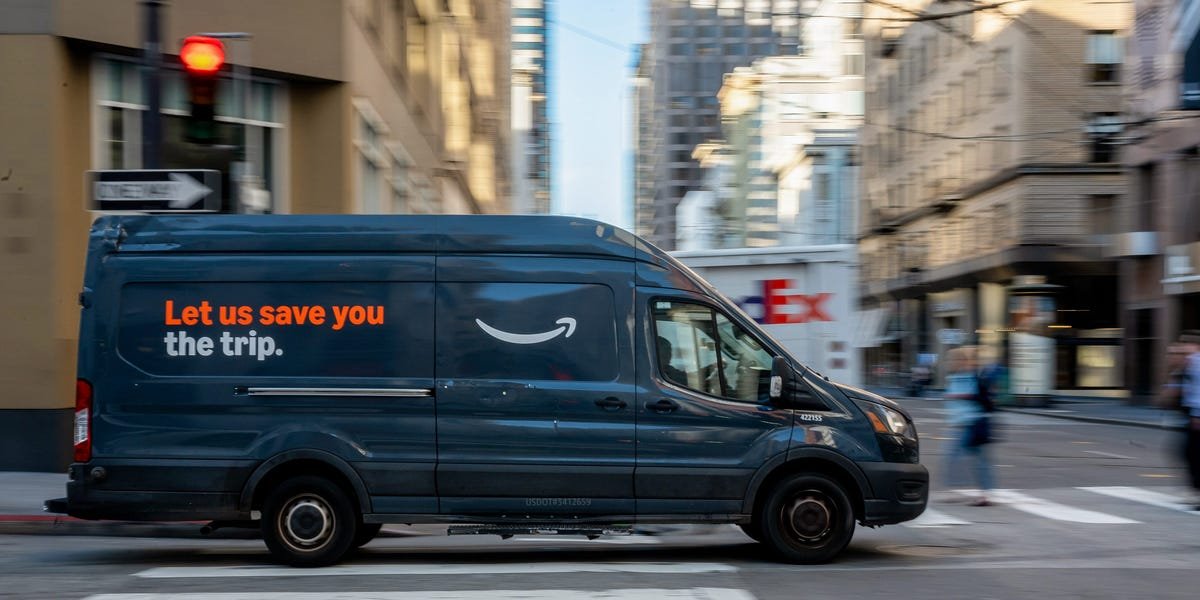


Amazon built the “Everything Store.” Now it’s trying to become the every-hour store.
The e-commerce giant is testing a new delivery system that breaks the day into 10 distinct windows spanning 24 hours, according to internal documents obtained by Business Insider.
That’s a meaningful expansion from Amazon’s traditional delivery hours, which typically run from 6 am to 10 pm. The new structure effectively turns delivery into a rolling, all-day cycle, with faster options carrying premium fees.
The initiative, led by Udit Madan, Amazon SVP of worldwide operations, began as a pilot program with plans to potentially expand across the network later this year, according to the documents.
Selling speed
If successful, it would mark one of the most significant changes to Amazon’s delivery model in years, shifting the company from offering fast shipping as a default to selling speed as a premium product.
As part of the effort, Amazon has explored charging extra fees for fast delivery options, including 45-minute and 2.5-hour services, according to the documents.
By expanding delivery hours and introducing paid upgrades for faster service, Amazon is trying to turn the final and most expensive stretch of its logistics network into a new source of profit.
According to internal projections, Amazon projects the new delivery fees and higher sales volume will ultimately make faster shipping a meaningful profit driver, even as it expects hundreds of millions of dollars in near-term costs.
“Explore avenues to monetize (charge ship-fee) on the last 1-hr of delivery,” one of the documents stated.
Starting as a small pilot
An Amazon spokesperson told Business Insider the company is conducting a “small pilot in a few US locations” to test a new delivery structure that will “introduce shorter delivery windows” and provide customers with “more frequent delivery options throughout the day.”
Amazon has not decided on the future rollout of the new program and is evaluating customer response before deciding whether to expand it more broadly, the spokesperson added.
This is unrelated to last week’s launch of 1-hour and 3-hour delivery options, the spokesperson also said. That built on a limited 30-minute ultrafast service introduced last year.
“We are always innovating on behalf of customers and continue to find new ways of offering them lower prices, greater selection, and more convenience,” the spokesperson said in an email statement.
Slicing up a day
Under the new system, Amazon divides the day into named, overlapping windows, each roughly three hours long.
The windows span early-morning slots like 3 am to 6 am through evening and overnight periods such as 8 pm to 11 pm and 11 pm to 4 am, each with internal codenames ranging from “Sunrise” and “Coffee” to “Nightowl.”
The new system also gives Amazon tighter control over how delivery options are presented.
According to the documents, Amazon wants to show customers specific arrival times, making delivery feel precise and predictable, not just fast. For example, it wants to say the package “arrives in 45 minutes,” instead of a window range, the documents showed.
The Amazon spokesperson said the company already provides delivery estimates like “arrive by,” and, in some cases, more precise timing as it continues to improve accuracy over time. Amazon is not moving to “exact, minute-by-minute scheduling,” the spokesperson added.
Amazon believes a steady, deliberate rollout of the new delivery service will help it better learn and measure the impact before expanding across the full network, according to one of the documents.
Speed is expensive
The plan to charge for faster delivery marks a broader shift for Amazon. For years, the company bundled new perks into Prime at no extra cost. Now it’s increasingly charging for premium features, from ad-free Prime Video and Whole Foods deliveries to services like One Medical.
For the faster delivery fee, Amazon benchmarked similar services from Walmart, Instacart, DoorDash, and UberEats, one of the documents showed.
The Amazon spokesperson said this is not a shift away from “fast, free delivery” or “a change in approach.” The Prime membership continues to offer “significant value, including fast, free delivery on millions of items, alongside optional faster delivery options in some cases,” the spokesperson added.
The push for all-day delivery and speed, however, comes at a cost.
One estimate, based on expanding the service to all sites by July, projects more than $330 million in costs this year and over $780 million next year. A slower rollout, reaching full scale by September 2026, would bring next year’s costs closer to $490 million, according to the documents.
At the same time, Amazon expects faster shipping to drive higher order volume and revenue, with the goal of ultimately making the model pay for itself.
The company projects the fully scaled program will increase sub-same-day delivery volume by at least 40 million units this year alone, helping offset the added costs through higher sales and new revenue streams, including premium delivery fees. Those fees are expected to generate at least $20 million in incremental revenue this year, according to the documents.
Over time, Amazon expects the model to turn profitable, projecting about $40 million in operating profit this year and roughly $260 million in 2027 if fully rolled out by September 2026, the documents added.
That helps explain why Amazon is moving quickly to expand all-day delivery. The company wants to “blitz scale” the model across its network this year after the current pilot test, according to one of the documents.
Have a tip? Contact this reporter via email at ekim@businessinsider.com or Signal, Telegram, or WhatsApp at 650-942-3061. Use a personal email address, a nonwork WiFi network, and a nonwork device; here’s our guide to sharing information securely.
Read the full article here