







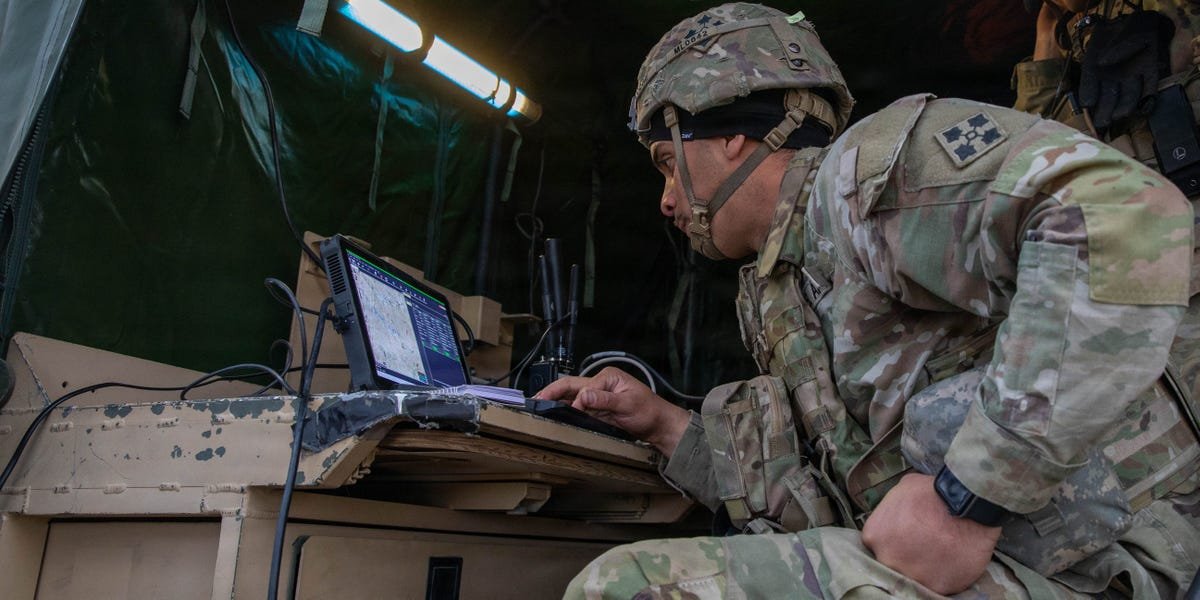


New US Army warfighting software is speeding up and simplifying the command job, a commander said recently, sharing that it lets him scrap the “hourlong staff meetings” to make decisions.
The Army, like other services, believes that future wars will be determined by the speed of decision-making. That’s where the new Next Generation Command and Control, or NGC2, program is expected to make a substantial impact and modernize how the service fights.
At Fort Carson, Colorado, the Army’s 4th Infantry Division has been testing NGC2 in a series of exercises. The most recent one, Ivy Sting 4, added more components to the system, with different types of sensors and weapons on the battlefield feeding into one system that everyone can access.
“So it’s all in one place, and it’s there very, very quickly, so that the staff can see it across their functional systems,” said Maj. Gen. Patrick Ellis, commander of the 4th ID, at a recent media roundtable, explaining that “the fires person can see what the logistician sees, can see what the intel person sees.”
“I don’t have to have the hourlong staff meeting anymore,” the general said.
“If we’re actually using the technology as the tool that we’re prepping on and that we’re also fighting on,” he said, “I could sit there, I can look at it, I can make decisions, I can say, ‘Hey, here are my priorities for this or that.’ We all agree on it, we click save, and that’s done.”
The Army has facilitated the development of NGC2 with both the 4th ID and 25th Infantry Division in Hawaii and industry teams, including Anduril and Lockheed Martin, pursuing a Silicon Valley-style approach aimed at moving faster and rapidly integrating soldier feedback, delivering fixes immediately rather than months or years later.
On the heels of Ivy Sting 4, more than two weeks of field testing that involved live-fire exercises and an electronic warfare jamming scenario, Ellis and others said that NGC2 was making planning and executing battlefield missions more effective.
“We are no longer fighting with the network; we are now fighting using the network,” Ellis said.
During the Ivy Sting 4 testing event, 20 different types of sensors, such as drones, electronic warfare systems, artillery, and Stryker vehicles, were linked together.
Data and artificial intelligence capabilities provide real-time information on the sensors. Soldiers can see how much ammunition they’ve got left or whether a Stryker will need maintenance or fuel soon. Simulations can predict what resources will be needed for certain tactics or actions, including different ways an enemy might attack.
As different platforms are brought onto NGC2, broadening what the platform can do, Army command and soldiers can see and communicate using the same data. The system is breaking down the silos that have previously hindered information flow.
“I’m feeling empowered as a commander to make more, better, and faster decisions because I’ve got access to all that data,” Ellis explained.
Many NGC2 components are being built with off-the-shelf technology and standard commercial software practices, and the vendor teams involved are working on the ground with soldiers. The closer working relationship means soldier feedback is being incorporated more quickly.
“We work through these obstacles, and we learn how to do something, and once we run into a roadblock, we figure out a way to solve that problem, and then that problem is now solved for the Army,” he said. “We’re not relearning these lessons over and over again.”
Read the full article here