







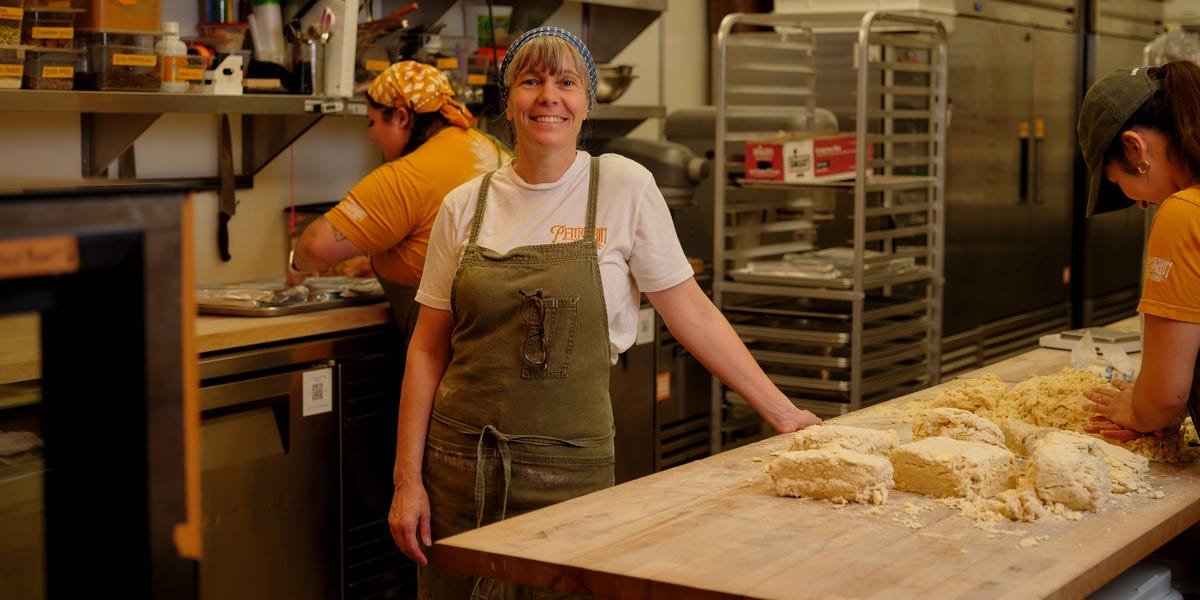


When Clémence de Lutz answered my phone call at 1 p.m. on a Friday afternoon in late February, she’d already been awake — and working — for 12 hours.
De Lutz owns Petitgrain Boulangerie, a tiny bakery tucked between a delicatessen and a nail salon on Los Angeles’ iconic Wilshire Boulevard. Five days a week, her alarm goes off at 12:48 a.m., giving her just enough time to get out of bed, walk the 10 blocks to the shop, and start shaping croissants by 1 a.m. She relieves her 23-year-old daughter, who works the 5 p.m. to 1 a.m. night shift.
Those early hours aren’t for show. They’re key to good business.
The most foot traffic happens between 8 a.m., when her bakery opens, and 10:30 a.m., she explained: “If we don’t have enough things to sell because we shaped too late or they went into the proofer too late, then we lose money.”
From 1 a.m. to 3 a.m., she works alone in the kitchen.
“It’s my favorite time of day,” said the mother of three, “because I just listen to true-crime podcasts.”
At 3 a.m., a second baker arrives, followed by three more, staggered at 4 a.m., 5 a.m., and 6 a.m. Front of house clocks in at 7 a.m., and the doors open an hour later. Regulars often line up well before then to secure their favorite pastries, including the most popular item: the plain croissant.
On Fridays, she typically works a half-day and focuses on business development. The Friday we chat is different.
“This week, I’m short-staffed,” she told me, stepping out of the kitchen to take the call. “I have a nice, healthy 45 minutes ahead of me. I’m just waiting for things to rise in the proofer.”
De Lutz was born in Paris and moved with her family to Washington, D.C., when she was eight. Summers were spent selling ice cream and washing dishes at the inn and restaurant her grandparents owned in the south of France. “My parents would just drop us off for the summer and be like, ‘Work for tips,'” she recalled.
She studied film and anthropology at Syracuse University, then moved to Los Angeles with plans to make documentaries. She tried the corporate route first, taking an executive assistant job at Fox, but it didn’t last. “I just couldn’t find my footing until I went back into food in my early 20s and was like, ‘Oh, this is what feels normal,'” she said. “Chaos feels normal.”
Turning a cubicle cookie side hustle into a career
While a desk job wasn’t a great fit for de Lutz, it led to a side hustle that would change the course of her career. She’d collect cookie orders from coworkers throughout the week and deliver her handmade creations on Fridays. Her cubicle cookie business eventually landed a spot on KCRW’s “Good Food,” an appearance she says “changed my life.” She quit her job, rented a commercial kitchen, and began working as a ghost pastry chef for restaurants. Baking evolved into teaching and consulting. For years, she helped other bakeries build menus and streamline systems, work that also served as real-time education on what it takes to succeed in the industry.
When the opportunity to run her own bakery fell into her lap — a friend she’d consulted for called her up and said, “Hey, I’m retiring, do you want my space?” — she jumped.
Taking over an existing kitchen space in LA typically comes with expensive delays and red tape. In Los Angeles County, she explained, commercial kitchens that sit empty for 90 days or more can trigger a permit reset. So, “when you find an owner who is willing to work with you and close the day before you want to open and just kind of negotiate key money for buying out the equipment, you can never pass that up.”
She has lived lean, she said, with no credit card debt or loans, so the risk of opening felt manageable.
“The values I grew up with have very little to do with money. In France, it’s not customary to value money or wealth. It’s really valuing being a tradesperson, being an expert in your field,” she said. “Taking risks was always easy because I had nothing to lose.”
Opening day: Selling 300 croissants in 1 hour
Petitgrain opened in May 2024. From the start, demand outpaced production.
Opening day, she made about 300 croissants. They didn’t last more than an hour. On day two, she about doubled the number and sold out again.
Since opening, the bakery has drawn steady crowds from Wednesday through Sunday, the days it’s open. Today, the operation is close to its ceiling.
“We’re pretty maxed out,” she said. Her 870-square-foot kitchen, equipped with one double-stack oven and one small proofer, produces 32 “books” of croissants a day. A book yields roughly 24 to 30 croissants, putting the daily volume at 700 to 900. Though the croissant is the top seller, she offers a variety of other pastries, including cinnamon, cardamom, and sausage rolls, as well as cookies, quiche, and scones.
The business worked from the get-go because she understood her baseline costs and built for sustainability. It helped that her landlord was committed to renting to small businesses at below-market rent, she added: “Rent is $4,100 a month, and we knew how much we needed to make to make rent.”
Early on, she kept a second job teaching baking classes, but within a couple of months of opening, she sold her share of the cooking school to focus fully on Petitgrain.
De Lutz said Petitgrain’s average monthly sales have climbed about 131% from 2024, when she first opened, as the team slowly increased production. Small upgrades, such as undercounter freezers, have helped drive another 20% in growth over the last few months, she added.
Her secret sauce: Social capital and ‘radical hospitality’
Having ripped open one of her flaky masterpieces myself, it’s hard to agree with de Lutz when she claims her croissants are “overhyped.”
“I’m not kidding,” she said when I chuckled. “I wake up every morning at 12:48 a.m., and my first thought is: ‘How can I live up to this hype?’ It’s a lot of expectations, but it’s sort of what drives you to be excellent.”
A big part of her immediate success, she believes, was timing. When Petitgrain opened, interest in croissants surged across Los Angeles.
“Everybody all of a sudden wanted to write about croissants,” she said. “It was just really lucky timing.”
Less visible, and perhaps more impactful than trends, however, were the relationships she’d built from being in the food and hospitality community for so long. Social capital, she said, is “the most important part of my story.” While it’s hard to quantify, “I think that has the biggest return.”
Her hiring model and teambuilding strategies are unique. At Petitgrain, she practices what she calls “both-of-house” training: everyone in back of house learns front of house, and everyone in front of house works at least one back-of-house shift weekly.
That way, “everyone understands the product better and has respect for their team members,” she said. She also rejects a traditional hierarchy and instead aims for shared accountability, anchored in wages.
“My business model is based on generous hospitality,” she said. “Everybody needs to earn a living wage, not like $20 an hour. Everyone here, with tips, is making at minimum $30 an hour. I don’t want anyone to have to work a second job.”
To make that work, she runs a tip pool, and she protects it. She refuses to hire ahead of revenue.
“Because the tip pool is such an important part of everybody’s paycheck, I’m really cautious,” she said. “I cannot bring in a new team member until we grow sales between 6 and 8% at a time because, if I add an extra person before revenue grows, everybody’s tip pool gets diluted.”
As of early 2026, she has a team of 13 bakers and baristas. When she does hire, credentials aren’t her priority. She’s looking for kindness, hustle, and curiosity.
“I don’t care if you went to culinary school. I don’t care if you worked at a Michelin-star restaurant,” she said. “Honestly, it’s not hard to make a croissant. It really isn’t. But if you are curious, if you are humble, if you work hard, you’ll figure it out. And 99% of the time, that yields a really great team.”
Underneath all of it is what she calls her core belief system: radical generosity, expressed through radical hospitality.
“There’s never a time when I have been radically generous and regretted it,” she said.
Read the full article here