







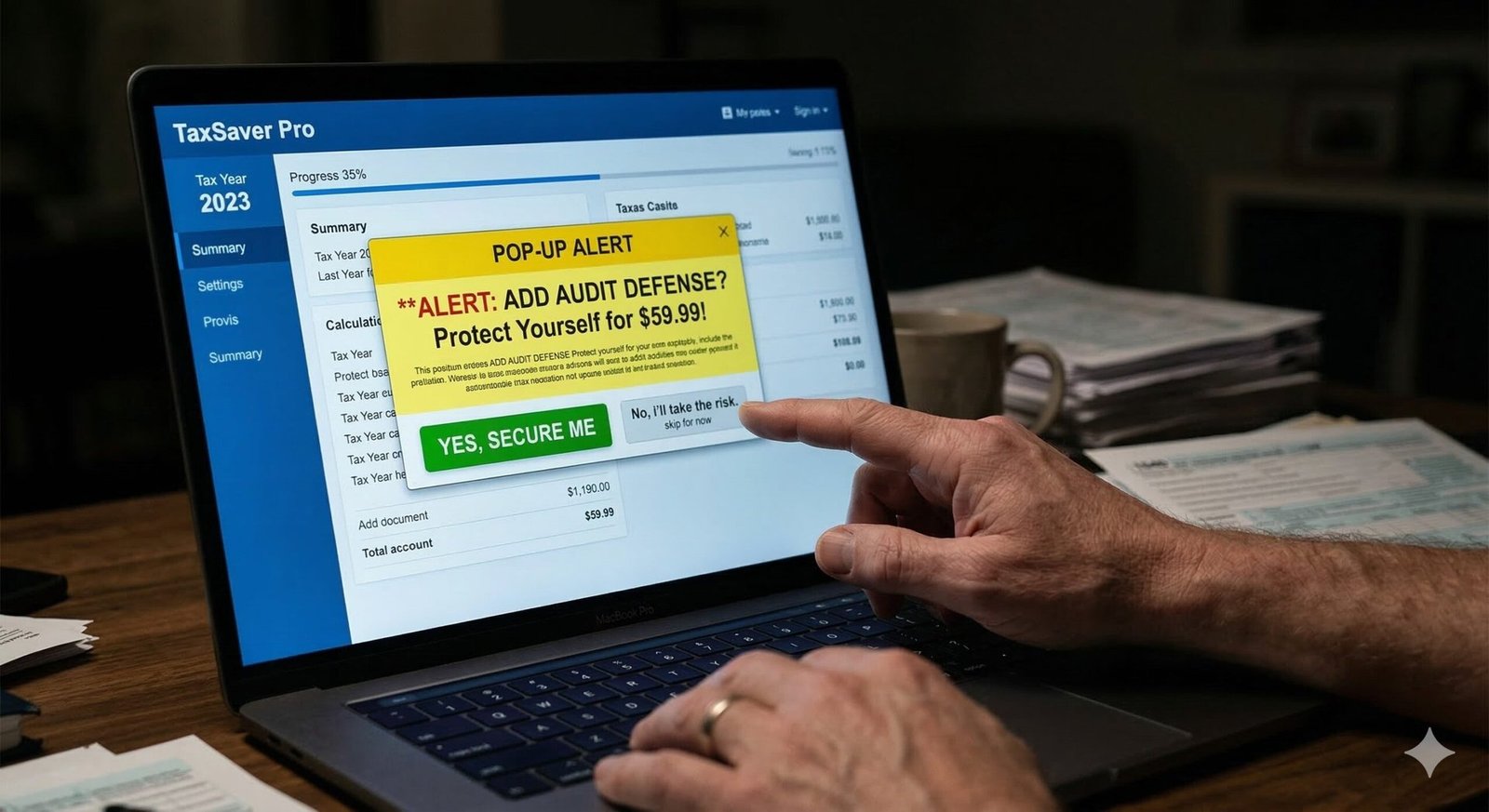


It’s late. You’re staring at your screen, exhausted from tracking down every last W-2 and 1099, and you’re finally ready to hit “File.” But before your tax software lets you finish your tax return, a warning flashes across the screen. For an extra $40 to $60, you can buy “Audit Defense” or “Worry-Free Audit Support.”
It sounds like a bargain when you imagine a team of menacing IRS agents knocking on your front door. But don’t fall for it. I’ve spent years watching the financial industry profit off fear, and this is one of their most reliable tricks.
Here’s why you should confidently click “No thanks” the next time your tax software tries to sell you audit protection.
1. You’re statistically invisible to the IRS
When you buy audit defense, you’re paying for insurance against an event that’s almost certainly never going to happen. The IRS is historically understaffed and doesn’t have the manpower to come after average Americans. According to recent data published by Nolo, the overall individual audit rate sits at just 0.4%.
If you’re a standard W-2 employee claiming the standard deduction, your risk drops even lower. The agency focuses its remaining firepower on the ultra-wealthy, large corporations, and complex partnerships.
Unless you’re making millions or claiming bizarre, red-flag deductions on a small business return, you aren’t on their radar.
2. Most audits are just a simple letter
When you hear the word “audit,” you probably picture a miserable afternoon sitting across a desk from a government agent while sweating under fluorescent lights. That isn’t how it works.
The vast majority of modern IRS audits are correspondence audits. This means the IRS sends you a letter in the mail saying it has noticed a discrepancy. Usually, it’s something minor, like your W-2 showing you made $50,000, but you accidentally typed in $5,000 on your return.
You don’t need a high-priced defense team to write a letter back or attach a forgotten document. You just need to follow the instructions in the envelope.
3. You’re buying a call center, not a shark lawyer
Read the fine print on these audit defense packages. You aren’t hiring a ruthless tax attorney to fight for your freedom in federal court. You’re generally getting access to a customer service representative or an enrolled agent who will review your documents and give you advice on how to respond to the agency.
They’ll hold your hand, but they won’t magically make the IRS go away. If you actually end up in a complex, high-stakes audit — the kind where you legitimately fear financial ruin — you’re going to need to hire your own independent CPA or tax attorney anyway. The software add-on isn’t going to cut it.
4. It doesn’t pay your actual tax bill
This is the biggest misconception I see every tax season. People think buying audit defense means they’re totally off the hook if they made a mistake. They aren’t.
If the IRS audits you and determines you owe an extra $2,000 because you claimed a deduction you weren’t entitled to, your audit defense program won’t pay that bill. You’re still strictly on the hook for the back taxes, plus any interest or penalties the IRS decides to slap on top.
You’re essentially paying a $50 upfront fee just to have someone confirm the bad news for you later.
What you should do instead
Keep your money in your wallet. File your return honestly, double-check your math, and keep your receipts in a safe place for at least three years. If you do receive a letter from the IRS, take a deep breath, read it carefully, and handle it.
If your situation really is a complicated mess because you own a small business or have complex investments, take the money you saved by skipping the software upsell and put it toward hiring a real, local CPA who can evaluate your specific situation from day one.
Don’t let tax software companies bully you into buying peace of mind that you don’t actually need. The math is on your side. Click “Decline” and go get some sleep.
Read the full article here